
Three Powerful Leadership Development Tools Organisations Often Confuse
In many organisations today, the words mentorship, coaching and sponsorship are used almost interchangeably. They appear in leadership discussions, development programmes and transformation strategies as if they represent the same intervention designed to help people grow.
They do not.
After more than four decades working inside organisations, advising executive teams and building leadership capability across multiple countries and industries, I have seen how easily these concepts become blurred. When organisations fail to distinguish between them, development initiatives often lose their power. People receive guidance but not opportunity. They receive advice but not advancement. They receive support but not exposure.
Understanding the distinction between mentorship, coaching and sponsorship is not simply a matter of terminology. Each serves a different purpose in shaping professional growth, leadership development and career progression.
Mentorship: The Wisdom of Experience
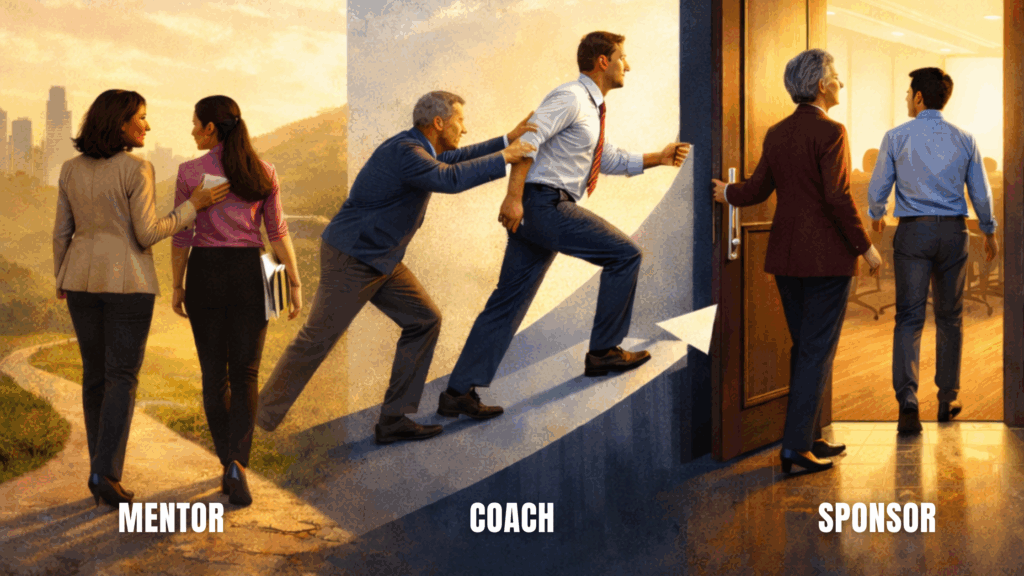
Mentorship is rooted in experience. It is the passing of knowledge from someone who has walked the path to someone who is still navigating it.
A mentor provides perspective, context and insight that cannot easily be found in textbooks or formal training. They share lessons learned through success and failure. They help individuals think through challenges, reflect on decisions and understand the broader dynamics of leadership and career growth.
Throughout my own career, mentorship has played an important role in shaping the leaders I have worked with and the professionals I have supported. The value of mentorship lies in its ability to accelerate wisdom. It helps individuals avoid unnecessary mistakes, develop stronger judgement and gain confidence in navigating complex environments.
Mentorship is not directive and it is not about solving problems for someone. Instead, it is about guiding thinking and expanding perspective. The mentor offers insight, but the individual ultimately makes their own decisions.
When mentorship is effective, it builds maturity, judgement and resilience over time.
Coaching: Unlocking Capability and Leadership Performance
Coaching operates very differently. While mentorship is anchored in experience, coaching is anchored in development.
In my work with executives and leadership teams across large organisations, coaching is often used to strengthen specific leadership capabilities or unlock performance potential. The focus is not on sharing personal experience but on helping individuals develop deeper self-awareness and sharpen their effectiveness.
Coaching creates a structured space for reflection and growth. Through questioning, feedback and accountability, individuals are encouraged to examine how they think, how they lead and how their behaviour influences outcomes.
Where mentorship often draws on past experience, coaching focuses on present performance and future capability. It may address leadership presence, strategic thinking, decision-making, communication or the ability to lead teams effectively in complex environments. Coaching is frequently time-bound and goal-oriented, designed to help individuals move from where they are to where they need to be.
At its best, coaching challenges leaders to grow beyond their comfort zones and become more intentional about how they lead.
Sponsorship: The Engine of Opportunity
Sponsorship is perhaps the most powerful and often the least understood of the three. While mentorship and coaching focuses on development, sponsorship focuses on opportunity and visibility.
A sponsor is someone who actively uses their influence to advocate for another person’s advancement. They ensure that talented individuals are not only developing their capabilities but are also positioned where their skills can be recognised and utilised.
In many of the transformation and leadership programmes I have designed, sponsorship has proven to be one of the most effective mechanisms for accelerating talent. When senior leaders deliberately sponsor emerging professionals, they create access to strategic projects, leadership exposure and critical decision-making environments. Sponsorship is not simply guidance or advice. It is active advocacy.
A sponsor speaks about an individual in rooms where that person may not be present. They recommend them for opportunities, endorse their capability and ensure that their talent becomes visible at the right level of the organisation.
This is particularly important in environments where talented individuals may otherwise struggle to gain access to influential networks or decision-making platforms.
Why the Distinction Matters
When organisations treat mentorship, coaching and sponsorship as though they are the same thing, they unintentionally weaken their talent development strategies.
Mentorship programmes may provide valuable advice but fail to create opportunities. Coaching initiatives may improve leadership capability but not address career progression. Leaders may believe they are supporting talent simply by offering guidance, while the individuals they are supporting remain invisible when opportunities arise. Development becomes meaningful in conversation but limited in impact.
In my experience working with executive teams and designing leadership frameworks, the organisations that truly develop talent are those that understand that growth requires multiple layers of support. Individuals need wisdom, capability and opportunity. Mentorship builds perspective. Coaching builds competence. Sponsorship creates visibility and access.
Building a Complete Development Ecosystem
Organisations that succeed in building strong leadership pipelines rarely rely on one single intervention. Instead, they create environments where mentorship, coaching and sponsorship operate together.
Mentors help individuals think more broadly about their careers and leadership journeys. Coaches help them sharpen the capabilities required to perform effectively. Sponsors ensure that talent is seen, trusted and given the opportunity to step into larger roles. Together, these relationships create a powerful ecosystem for growth.
Over the years, I have seen how transformative this alignment can be. When people are both developed and advocated for, their potential expands dramatically. They move beyond simply learning and begin to lead, contribute and shape the organisations they are part of.
Ultimately, organisations do not grow because they talk about talent. They grow because they understand how to cultivate it, support it and position it where it can thrive.
About the Author
Nimee Dhuloo holds a Masters in Management Science, is a Master HR Professional and CEO of Chien Consulting, with over 40 years of experience leading organisational transformation, leadership development, and culture integration initiatives across multiple industries in Africa.
Learn more about Chien Consulting services