
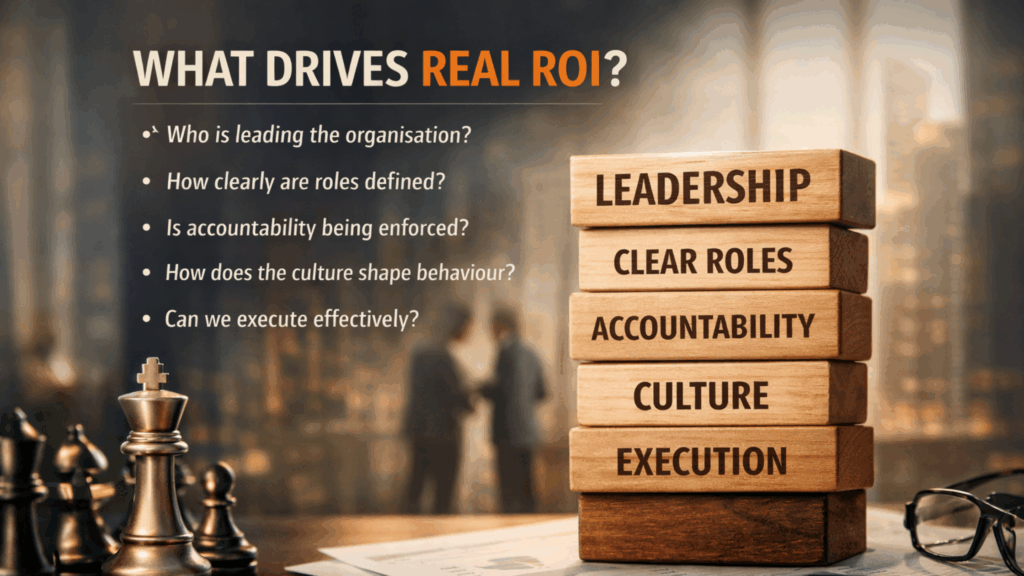
RETURN ON INVESTMENT.
Executives talk about it constantly. Finance teams measure it relentlessly. Investors demand it. Strategy presentations promise it. Yet after more than four decades working inside organisations, advising executives, and building businesses across multiple countries, I have come to realise something important.
Most organisations misunderstand what actually drives real ROI.They measure outputs, but they rarely examine the conditions that create those outputs.
ROI is not created by spreadsheets.It is created by people, leadership decisions, organisational discipline, and execution culture.
When those elements align, the numbers follow. When they do not, no amount of strategy decks or financial modelling will save the outcome.
ROI IS NOT CREATED IN FINANCE
One of the biggest misconceptions in business is that ROI is a financial calculation.
It is not. Finance measures the result. It does not create the result.
Real ROI is built long before the numbers appear on a balance sheet. It is built in the quality of decisions leaders make about people, structure, accountability, and execution.
When I work with executive teams, the conversations often begin with questions like:
- Why are our margins declining?
- Why are we missing targets?
- Why are projects failing?
- Why are teams underperforming?
Rarely is the answer purely financial.
More often, the root cause sits somewhere else entirely.
- Unclear roles
- Poor leadership capability
- Misaligned incentives
- Weak accountability structures
- Culture that tolerates mediocrity
- Strategy disconnected from execution
These are human and organisational issues, not financial ones and until they are addressed, the organisation will struggle to generate sustainable returns.
LEADERSHIP QUALITY IS THE GREATEST ROI MULTIPLIER
Across every organisation I have worked with, from large corporates to fast-growing companies, one factor consistently determines performance.
Leadership maturity.
The quality of leadership in an organisation directly determines how well strategy translates into results.
Strong leadership creates clarity across the organisation. People understand the direction the business is moving in and what is expected of them. It strengthens accountability for performance because roles, responsibilities, and outcomes are clearly defined. Teams begin to operate in alignment rather than in silos, which improves collaboration and reduces internal friction. Decisions are made faster because leaders are confident about their mandate and authority. This environment naturally drives higher levels of employee engagement, as people feel connected to the purpose of their work and see how their contributions matter. Over time, this combination of clarity, accountability, and alignment builds a culture of disciplined execution where strategy is not only discussed, but consistently delivered.
Weak leadership on the other hand creates the opposite. Uncertainty spreads, accountability disappears, teams operate in silos, decisions stall. Energy is spent managing internal friction instead of delivering results. No strategy can outperform the leadership that is responsible for executing it and no organisation can generate strong returns while carrying weak leadership capability.
ORGANISATIONAL DESIGN DETERMINES EXECUTION
Many organisations invest heavily in strategy development but spend very little time ensuring the organisation is structurally capable of delivering that strategy.
This is where ROI often quietly erodes.
- If roles are unclear, decisions become slow
- If reporting lines are confusing, accountability disappears
- If performance expectations are not defined, results become inconsistent.
The most successful organisations understand that structure is not administrative, it is strategic. When an organisation is well structured, decision rights are clearly defined and people understand where authority sits, responsibilities are unambiguous, which reduces duplication, confusion, and gaps in delivery.
Teams gain a clearer understanding of how their work contributes to broader business objectives, creating stronger alignment between individual effort and organisational goals. In this environment, performance can be measured more accurately and managed more effectively, allowing leaders to address challenges early, recognise strong contributions, and drive consistent results across the organisation.
This is when organisations begin to operate with discipline rather than confusion and disciplined organisations outperform disorganised ones every single time.
CULTURE IS A FINANCIAL DRIVER
Culture is often spoken about as something soft or intangible. In reality, culture is one of the most powerful drivers of financial performance.
Culture quietly influences many of the behaviours that ultimately determine organisational performance. It shapes how quickly teams respond when problems arise and how seriously individuals take accountability for their responsibilities. It influences whether employees feel encouraged to innovate and contribute new ideas, or whether they avoid taking initiative out of fear of failure. Culture also affects how decisions are made, whether they are thoughtful, collaborative, and decisive, or delayed by uncertainty and hesitation.
Most importantly, it determines how much discretionary effort people are willing to bring to their work, the extra care, energy, and commitment that employees choose to invest beyond what is formally required.
A culture that rewards ownership and performance will produce very different financial outcomes to one that tolerates blame-shifting and complacency. In the organisations where I have seen the strongest financial performance, culture was not accidental.
It was intentionally built, protected, and reinforced by leadership behaviour.
EXECUTION IS THE REAL STRATEGY
One of the most common mistakes organisations make is believing that strategy itself creates value. Strategy is important, but execution creates ROI.
I have seen beautifully written strategies fail completely because the organisation lacked the operational discipline to implement them.
Execution becomes possible when an organisation operates with clear goals that everyone understands and works toward. Accountability is defined so that individuals know exactly what they are responsible for delivering, eliminating ambiguity and reducing the risk of work falling through the cracks. Performance is managed consistently, allowing leaders to monitor progress, address challenges early, and recognise strong contributions. At the same time, leadership alignment ensures that senior teams are moving in the same direction rather than sending conflicting signals to the organisation.
Without these, strategy remains theoretical and with them, strategy becomes reality.
THE HIDDEN TRUTH ABOUT ROI
Real ROI is not a financial conversation. It is a leadership conversation.
It is a conversation about leadership and the organisational conditions that shape performance. It requires a clear understanding of who is leading the organisation and whether those individuals have the capability and maturity to guide it effectively. It involves examining how clearly roles are defined so that responsibilities are understood and work is delivered with precision. It also requires an honest assessment of whether accountability is truly enforced or merely spoken about in principle. Culture plays a central role in this discussion, as it influences how people behave, make decisions, and respond to challenges.
The companies that understand this outperform their competitors not because they have better spreadsheets, but because they have built stronger organisations and strong organisations generate strong returns.
AS A LAST THOUGHT
If there is one question every executive team should ask themselves, it is this.
Are we trying to improve our financial results, or are we improving the organisation that produces those results?
Because real ROI does not begin in finance, it begins with leadership, structure, culture, and execution and when those foundations are strong, the numbers tend to take care of themselves.
ABOUT THE AUTHOR
Nimee Dhuloo holds a Masters in Management Science, is a Master HR Professional and CEO of Chien Consulting, with over 40 years of experience leading organisational transformation, leadership development, and culture integration initiatives across multiple industries in Africa.